
Reading as Resistance: Investigating the Power of Young Adult Novels
Reading as Resistance: Investigating the Power of Young Adult Novels
What do you think of when you think of a book? Maybe you have fond memories of stories from your childhood. Maybe you remember the dusty, old textbooks you had to memorise during your school years. Or maybe you think of cosy Sunday afternoons curled up in your favourite chair with a good novel, a steaming cup of tea in your hand as the rain taps gently on the window.
But have you ever thought about the powerful potential of books? Have you imagined a novel as something radical – like a map for navigating an increasingly complex world, a tool for empowerment, or an act of activism? Have you ever considered that literature can play an important role in causes like the fight for reproductive rights?
Reproductive Rights in America: A Geographical Lottery
In the United States, reproductive rights have long been the site of a social, cultural, and political battleground. In 2022, that struggle intensified when the Supreme Court overturned Roe v. Wade, the landmark ruling that recognised access to abortion as a constitutional right.
Since then, the US has become a patchwork of restrictions. In some states (like Texas, Oklahoma, or Arkansas), abortion is banned entirely; in others (like Florida, Georgia, or Iowa), it’s banned from as early as six weeks – often before a person even knows they are pregnant.
Recent political shifts have further impacted access. We’ve seen the current administration revoke executive orders designed to protect and expand access to reproductive healthcare. We’ve seen a bill passed that includes provisions to defund Planned Parenthood, a non-profit organisation that provides affordable sexual health services, education, and advocacy. And we’ve also seen reproductiverights.org – a government website informing people about their rights and how to access reproductive healthcare services – pulled from the internet.
The steady erosion of reproductive rights has led to a rise in so-called ‘abortion deserts’ – regions where patients must travel 100 miles or more to reach an abortion clinic. As a result, more people are travelling further than ever before to access basic reproductive healthcare: approximately 142,000 people crossed state lines for an abortion in 2025, while over 155,000 did so in 2024 – a figure that is close to double the number who travelled in 2020.
This erosion of reproductive rights has also disproportionately affected young people. Of the approximately 10.7 million adolescent girls living in the United States, more than 7 million live in states with abortion bans, restrictive gestational limits, or that require permission from a parent, pushing access to reproductive healthcare even further out of reach.
Abortion in Young Adult Literature
Literature has been and continues to be an important medium for representing, discussing, and interrogating the world we live in. Within young adult (YA) literature, and particularly in an American context, topics like teen sex, pregnancy, and abortion have typically been explored in what is known as the ‘problem novel’, a genre of YA fiction that emerged and peaked in the 1960s and 1970s and remained popular into the late 1990s and early 2000s. These stories were formula-driven, melodramatic, and moralistic; they were designed to be as ‘scary’ as possible, teaching readers that only ‘bad’ girls have sex, get pregnant, or need an abortion – often with dire consequences.
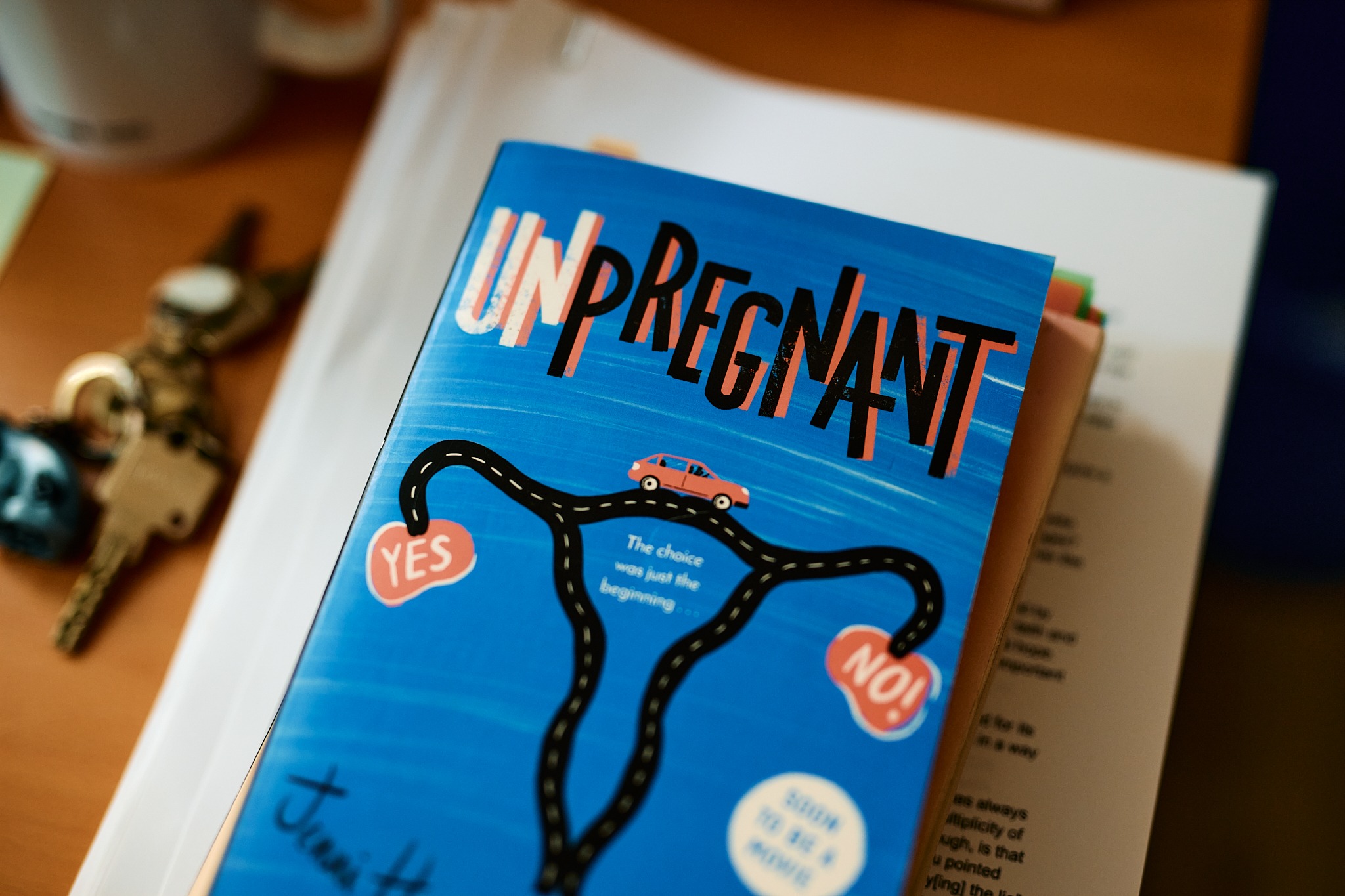
In recent years, though, a new kind of narrative has emerged: titles like Plan A by Deb Caletti (2023), Girls on the Verge (2019) by Sharon Biggs Waller, and Unpregnant by Jenni Hendriks and Ted Caplan (2019) all offer more nuanced portrayals of these themes. These portrayals have one thing in common: they follow a pregnant teenage girl living in a state where abortion is illegal as she drives across multiple state lines to access the healthcare she needs. I call these kinds of books ‘abortion road trip novels’.
From Shame to Social Change
Remember that idea of books being radical? That’s where my research comes in. I investigate how the stories of the present move away from the shame-filled tales of the past, instead aligning themselves with reproductive justice – a framework and social movement that thinks about the experience of reproduction and advocates for three fundamental rights:
- The right not to have a child;
- the right to have a child; and
- the right to parent children in safe and healthy environments.
So, how has the relationship between YA literature and abortion evolved over the last few decades?
Firstly, there has been a major shift in how these stories are told: these books aren’t concerned with the moral dilemma of whether to get an abortion, but rather the logistical challenge of how to get one. Instead of perpetuating stigma like its problem novel predecessors, twenty-first-century YA attempts to dismantle it by educating and empowering readers.
Secondly, novels like Plan A, Girls on the Verge, and Unpregnant also participate in what is known as ‘abortion storytelling’ – a reproductive justice tactic where women share their lived experiences of abortion in order to normalise it, thus paving the way for greater reproductive freedoms. By blending their personal experiences, the current political climate, and fiction, the authors of these texts create narratives that participate in this practice in new and exciting ways. They demonstrate how the act of storytelling can cross and blur the boundaries between real and imagined versions of the world and, by re-writing the script for how we think about abortion, have a profound impact on young people. This means that we can understand abortion road trip novels as literary acts of political resistance.
Read, Resist, Repeat: Stories as Political Resistance
Thinking about activism and resistance in literature for young people goes beyond the fight for reproductive rights. In fact, many of the issues at the heart of this research are connected to others created by the rise of right-wing and authoritarian thinking, politics, and policies in the US more broadly. For example, a recent op-ed in The Advocate pointed out how “the movements to restrict gender-affirming care [for transgender individuals] and abortion care are evolving together” as policymakers use parallel tactics to limit access to both.
Similarly, as my colleagues and I have highlighted through our work at the Banned Books Network Münster, the sharp rise in book banning since 2020 has had an effect on how young people learn about bodily autonomy. Recent censorship efforts have seen a surge in the banning of nonfiction titles, resulting in the removal of sex education books from school and public libraries and the introduction of so-called ‘educational gag orders’ that forbid teachers from discussing sexuality and gender in the classroom.
Stories are powerful
As YA author Seema Yasmin writes:
“Books are potent engines of empathy; sentences hold the power to disrupt and dismantle.”
We live in challenging times. But radical children’s and young adult literature has the potential to empower its readers, allowing them to harness activism, challenge the status quo, and (re)shape cultural narratives.
The impact of novels like Plan A, Girls on the Verge, and Unpregnant will no doubt be felt far beyond their pages. In the face of an increasingly conservative political landscape, my research demonstrates how crucial it is that we study these stories now.
Do you want to know more about the author? Stay tuned for our interview with Dr. Jennifer Gouck.